

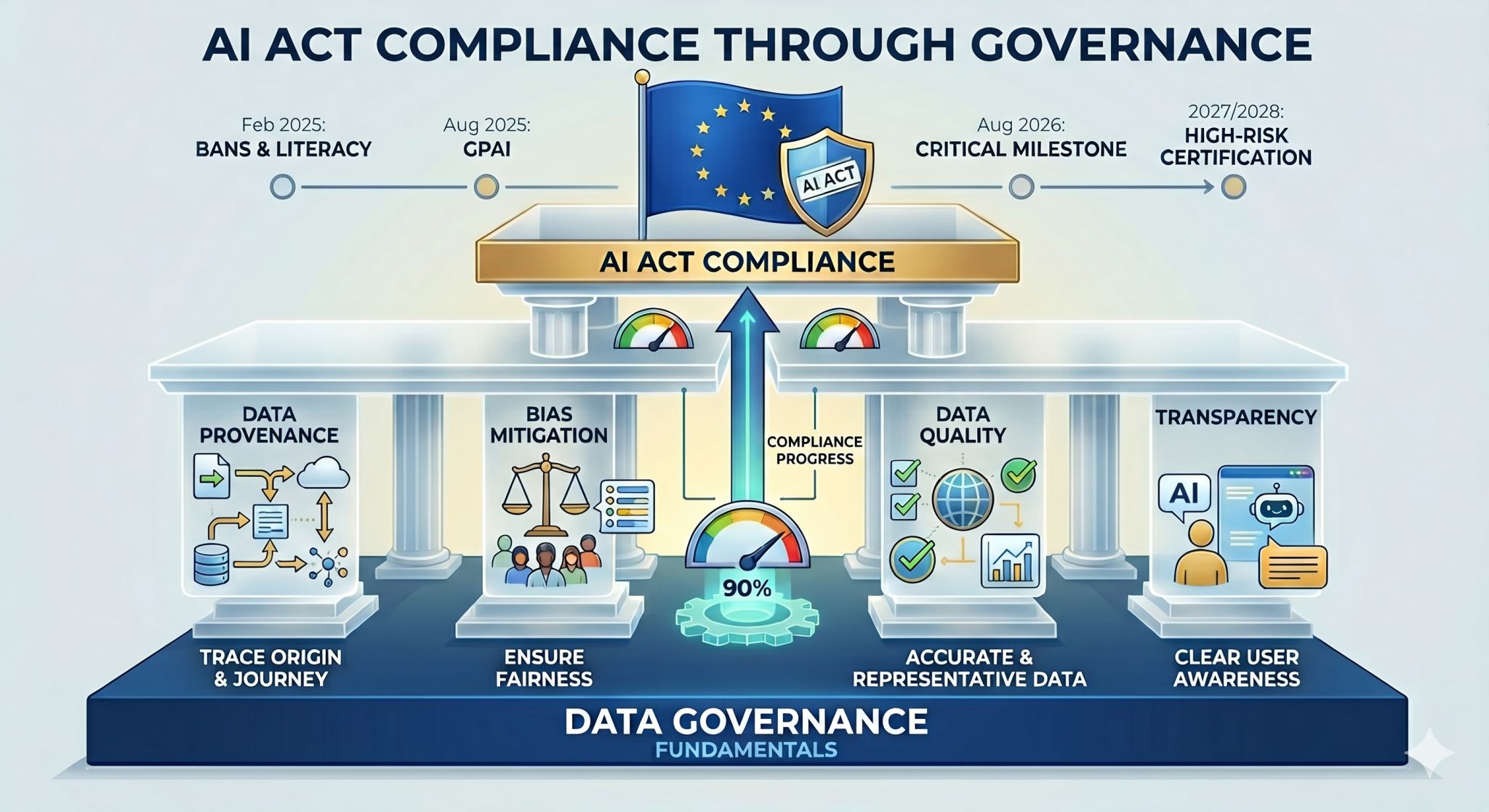
As we proceed toward the August 2026 milestone (official enforcement date for universal transparency obligations and strict controls on High-Risk AI) I see more and more C-level executives treating the EU AI Act as just another legal checkbox (like GDPR) or a purely technical task for the IT department.
The reality, however, is slightly different!
At its core, the AI Act doesn’t just judge the algorithms. It judges the data upon which these algorithms are trained and operated.
If you look closely at the requirements for High-Risk AI systems, as well as the transparency obligations for everyday tools like customer service chatbots, the regulation demands critical pillars that cannot be ignored:
- 𝐃𝐚𝐭𝐚 𝐏𝐫𝐨𝐯𝐞𝐧𝐚𝐧𝐜𝐞 & 𝐋𝐢𝐧𝐞𝐚𝐠𝐞: You must prove where your data originated, how it was collected, and trace its entire journey.
- 𝐁𝐢𝐚𝐬 𝐌𝐢𝐭𝐢𝐠𝐚𝐭𝐢𝐨𝐧: Datasets must be continuously monitored for biases that could lead to discrimination (e.g., in AI tools used for HR hiring or Credit Scoring).
- 𝐃𝐚𝐭𝐚 𝐐𝐮𝐚𝐥𝐢𝐭𝐲 & 𝐑𝐞𝐩𝐫𝐞𝐬𝐞𝐧𝐭𝐚𝐭𝐢𝐯𝐞𝐧𝐞𝐬𝐬: Data must be accurate, representative, traceable, and continuously governed.
In other words, 𝐲𝐨𝐮 𝐜𝐚𝐧𝐧𝐨𝐭 𝐡𝐚𝐯𝐞 𝐂𝐨𝐦𝐩𝐥𝐢𝐚𝐧𝐭 𝐀𝐈 𝐰𝐢𝐭𝐡𝐨𝐮𝐭 𝐦𝐚𝐭𝐮𝐫𝐞 𝐃𝐚𝐭𝐚 𝐆𝐨𝐯𝐞𝐫𝐧𝐚𝐧𝐜e.
If a company’s data strategy is fragmented, if data silos persist, and if there is no clear data ownership, deploying any AI system becomes a massive regulatory risk.
Organizations that treat governance as infrastructure, and not bureaucracy, will adapt significantly faster to the AI regulatory era.
At INESIS, this is exactly the transition we help organizations navigate.
𝐓𝐡𝐞 𝐀𝐈 𝐀𝐜𝐭 𝐰𝐚𝐬𝐧’𝐭 𝐝𝐞𝐬𝐢𝐠𝐧𝐞𝐝 𝐭𝐨 𝐬𝐭𝐨𝐩 𝐢𝐧𝐧𝐨𝐯𝐚𝐭𝐢𝐨𝐧. 𝐈𝐭 𝐰𝐚𝐬 𝐛𝐮𝐢𝐥𝐭 𝐭𝐨 𝐞𝐧𝐟𝐨𝐫𝐜𝐞 𝐚𝐜𝐜𝐨𝐮𝐧𝐭𝐚𝐛𝐢𝐥𝐢𝐭𝐲. And accountability always begins by establishing a robust Data Governance framework.